
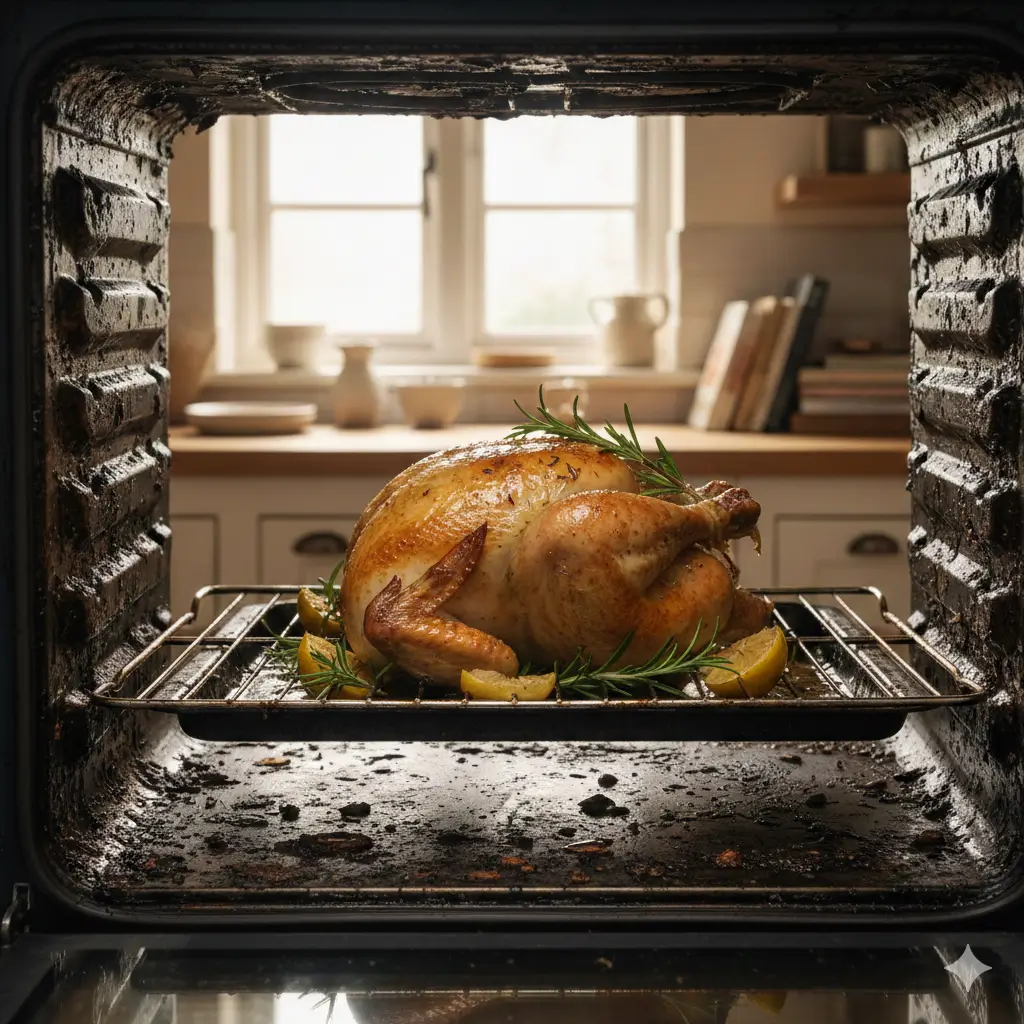
Can a dirty oven affect the taste of your food? The answer is yes — and most UK households have no idea this is happening. You follow the recipe perfectly, use fresh ingredients, set the right temperature — yet something still tastes off. The real culprit could be hiding inside your oven.
Old grease, burnt carbon, and baked-on food residue don’t just sit there quietly. Every time you cook, they release smoke particles and odour compounds that circulate inside the oven cavity and settle directly onto your food. The result is food that tastes bitter, smoky, or simply not right — no matter how well you cook.
Can a Dirty Oven Affect the Taste of Your Food?
Every time your oven heats up, old grease and carbon deposits on the walls, floor, and fan burn again. This releases tiny smoke particles and odour compounds that circulate inside the oven cavity — and settle directly onto your food as it cooks.
The result? Roast chicken that tastes faintly bitter. Baked goods with an odd, smoky undertone. Pizzas that smell burnt even when they’re not. These are not imaginary — they are real chemical changes caused by contaminated air inside your oven.
The Food Standards Agency (FSA) recommends that all food preparation equipment, including ovens, be kept clean to prevent contamination. A dirty oven is, in food safety terms, a contaminated cooking environment.
The Science: What’s Actually Happening Inside Your Oven
When animal fats and food oils are repeatedly heated to high temperatures, they undergo a process called oxidation and pyrolysis — essentially, they burn and break down into carbon compounds. These compounds coat the inside of your oven and, once baked on, continue to release volatile organic compounds (VOCs) every time the oven is used.
Baking is particularly sensitive to this. Cakes, bread, and pastries absorb surrounding air during cooking — meaning they are directly exposed to anything circulating inside a dirty oven. This is one reason why home bakers often notice their results improve dramatically after a professional clean.
Other Ways a Dirty Oven Damages Your Cooking
Uneven heat distribution. Carbon build-up on oven walls and the fan guard absorbs and blocks heat rather than allowing it to circulate evenly. This leads to hot spots and cold spots, resulting in food that’s overdone on one side and undercooked on the other.
Wrong cooking temperatures. A heavily soiled oven struggles to reach and hold its set temperature accurately. If your oven thermostat reads 200°C but the actual internal temperature is lower due to heat being absorbed by carbon deposits, your food will consistently undercook — something many people blame on their oven being faulty when it’s actually just dirty.
Steam and moisture build-up. Grease traps moisture inside the oven cavity, creating a damp cooking environment. This affects crisping and browning — why your chips or roast potatoes come out soggy rather than golden, even at high temperatures.
Is It a Health Risk Too?
Yes, and this is underappreciated. Old grease in ovens can harbour harmful bacteria if it contains food particles. More significantly, heavily carbonised ovens produce smoke containing polycyclic aromatic hydrocarbons (PAHs) — compounds linked to health concerns with repeated long-term exposure.
The NHS advises reducing exposure to cooking fumes where possible, particularly in poorly ventilated kitchens. Keeping your oven clean is one of the most straightforward ways to reduce smoke and fumes at the source.
When DIY Cleaning Isn’t Enough
A quick spray with a supermarket oven cleaner handles fresh surface grease, but it doesn’t remove baked-on carbon from the oven fan, rear baffle, door seals, or between the glass panels — the areas where the worst contamination accumulates.
A professional oven clean goes much further. Technicians from Oven Support dismantle removable parts, clean each component individually using eco-friendly, fume-free solutions, and reassemble everything to manufacturer standard. Customers consistently report that their food tastes noticeably better after a professional clean — not a placebo effect, but a genuine improvement in the cooking environment.
How Often Should You Book a Professional Clean?
For most UK households cooking daily, every 6 to 9 months is the recommended interval. If you bake regularly, cook strong-smelling foods like fish or game, or notice your oven smoking when preheating, it’s worth booking sooner.
Oven Support covers over 90% of the UK, with local professional cleaners available across Birmingham, Manchester, Bristol, Leeds, Nottingham, Sheffield, and many more cities. Enter your postcode to check availability and get an instant quote.
Quick Tips to Protect Your Food in Between Cleans
- Use an oven liner to catch drips before they carbonise on the oven floor — Oven Support stock professional oven mats designed for this purpose
- Cover dishes when roasting meat to reduce fat splatter onto oven walls
- Wipe fresh spills once the oven cools — they’re far easier to remove before they bake on
- Run your extractor fan during cooking to reduce fume and grease build-up — or book an extractor fan clean alongside your oven service
Final Thought
A clean oven isn’t a luxury — it’s a basic part of cooking well. If your food hasn’t been tasting quite right lately, the answer might not be in a new recipe. It might simply be time to book a professional clean.
Check your postcode and book with Oven Support today →
Useful references: Food Standards Agency · NHS — Cooking Fumes · National Fire Chiefs Council